
Meet Jasmijn Muskens
ehind every object, there is a story.
For this new interview, I had the pleasure of speaking with Rotterdam-based designer Jasmijn Muskens. Working across textiles, furniture and spatial design, Jasmijn creates playful, sculptural objects that blur the line between functionality and art.
We talked about her creative journey, the influence of her family, her love for materials, and how a simple cushion can become a companion in everyday life. She also shares a glimpse into her studio practice, her favourite places in Rotterdam, and the story behind the graphic shapes that have become a signature of her work.
I hope you'll enjoy discovering the person and the ideas behind these colorful creations as much as I did.

How did you become a textile designer, and when did you start your studio in Rotterdam? Was there a trigger moment when you thought, "I want to create sculptural, colorful cushions"?
I actually work across different design disciplines. I first started my studio in The Hague, where I studied and lived, and later moved to Rotterdam in 2022. I graduated in furniture design in 2017 with a line of modular furniture, and in the years that followed I mostly designed larger pieces and was often asked to create spatial designs as well.
Before art school, though, my background was in fashion. I started my own fashion labels while studying, and I always kept a strong connection to textiles. I love that with textile I can make everything myself — it’s forgiving (unlike wood), hands‑on and intuitive.
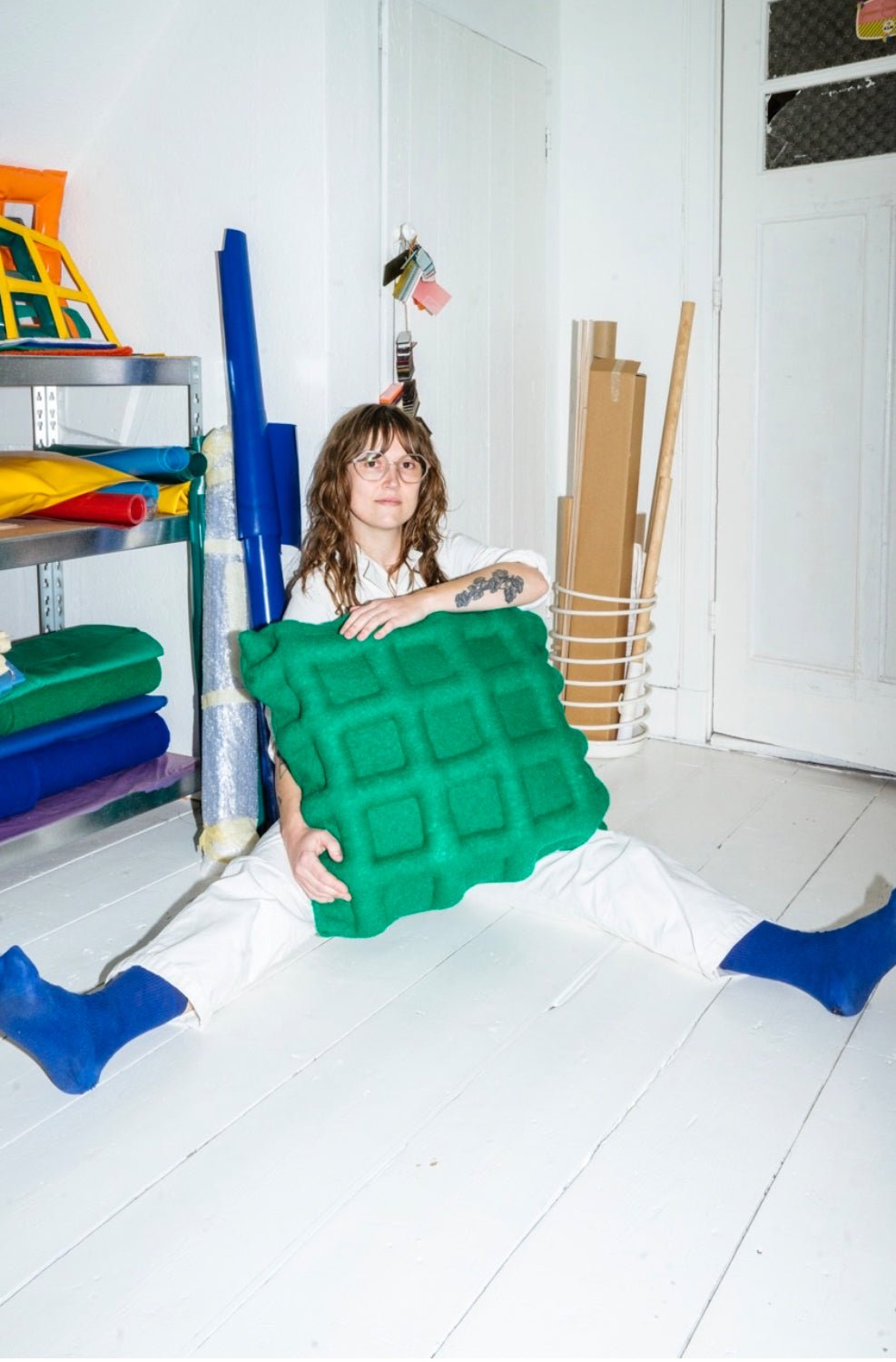
The cushions started very naturally. I originally made them for my own home, just as an experiment with color and sculptural forms. Everyone who visited asked, “What are these?!” That reaction made me realise there was something there. I wanted to create something playful, tactile, and accessible — something I could produce myself and offer to others. That’s how the pillows became part of my practice.

What does a typical day in your studio look like? How does an idea become a finished cushion? You mention your "material library"—how do you choose your materials and textures for each piece?
A typical day in my studio is very hands‑on. It’s usually just me, headphones on, a podcast playing, a big pot of tea next to me, and a table full of materials. My design process always begins in my sketchbook or behind my laptop, but the moment I can start making prototypes — or the actual piece — is when the work really comes alive for me.
Most of my ideas start with the material itself. I often look at a material and immediately know what it needs to become. And when I start with a design, my first question is usually: what material should this be? Tactility is the most important part of my work. I make objects to be touched, held, and used, so the feel of a piece guides almost every decision.
My “material library” is a collection of leftovers from previous projects, things I’ve found while thrifting, and random discoveries from hardware stores — which are honestly my favourite places to think. When I’m stuck on a design, I dig through that library. Those scraps and odd materials always spark new ideas or unexpected directions.

Your grandfather was a metalworker and jack-of-all-trades, and your mother ran a children's clothing brand from your garage. How did this creative environment and diversity of materials influence your work today?
It’s really what made me the designer I am today. I can never choose just one material because I love them all, and that shows in my work — I move easily between textiles, furniture, clothing, and spatial design.
My grandfather made everything himself. After he passed, I found a small wooden block with a tiny dent in it. My grandmother told me, “Oh, he made that to cut his pills.” That was so him: he saw a problem and immediately built a solution. Their whole house is basically a museum of his handiwork.
My mother had a children’s clothing label when I was little — my sister and I were mostly dressed in her designs — and she still sews most of her own clothes today.
Growing up around that mindset made working with materials feel completely natural. It taught me to be resourceful, curious, and unafraid to experiment, which is still at the core of my practice today.

You say your objects "become our companions in the daily search for meaning in life." What do you mean by that? How can a cushion play that role?
To me, objects are never just objects. We live with them, we touch them every day, and they quietly shape how we feel. A cushion might seem simple, but it’s something you hold, lean into, rest with — it becomes part of your daily rhythm.
My work is very much about that relationship. I make pieces that are a bit character‑like, so they almost feel like companions. They’re doing life with you.
I think meaning often comes from these tiny, physical interactions. A cushion can’t solve anything, of course, but it can offer a sense of grounding, softness, or play.
My home is also very colourful, because colour genuinely makes me happy. Your environment — especially your home — has such a big impact on your mood. Surrounding yourself with things that feel warm, soft, or joyful can shift how you move through the day. That’s the role I hope my pieces can play: small companions that quietly support you, simply by being there.

Your cushions have architectural, almost sculptural forms. How do you arrive at these shapes? Do you start from a sketch, a volume, an experimentation with fabric?
I’ve always loved graphic shapes — forms that immediately tell you what they are. And grids have a special place in my heart. Whenever I see an old metal grid piece, like the Niels Gammelgaard chairs, I instantly adore it. Those shapes just live in my mind; they’re forms I return to naturally and repeat in different ways.
Translating them into cushions started as an experiment with fabric. It became a kind of research into how to “print” without actually printing — letting the construction create the pattern instead of ink.

Is there a cushion or piece you've created that you're particularly proud of? Or a moment when you felt you'd truly found your voice as a designer?
The piece(s) I’m still most proud of is my graduation project: a modular furniture series called Komt Goed. You can already see the graphic shapes in that work that I keep returning to now — the same kind of forms that show up in my cushions. It was the first time I felt like, “Ah, this is my language.” Everything I’ve made since somehow traces back to that moment.
Your favorite spots in Rotterdam: a restaurant, a café, a shop not to miss?
There are so many, but okay — top three.
I love children’s picture books, and one of the best shops for them in the Netherlands is De Kleine Kapitein, which luckily is right here in Rotterdam.
For coffee and lunch, it’s UEB – Urban Espresso Bar. It used to be on the corner of my street, and it’s still very close to my studio, so it feels like a little home base.
And for food, Restaurant Rotonde is just an absolute gem. Everything about it is good — the atmosphere, the food, the whole experience.

Instagram Jasmijn Muskens
You can discover her work in Re-leaf selection.